Handwriting recognition software for indexing?

15 postsstarted by spencerschumann 26,488 viewsoriginal topic

New Member
#1
I saw a snippet of video yesterday depicting pioneers pushing handcarts over the plains and through rivers. I marveled at how far we've come technologically since then. This journey was a tremendous, difficult, even life threatening task for the early saints, but today we can simply board a plane or hop in a car and comfortably make the same trip they took in a matter of hours. I liken that experience of the pioneers to the massive genealogical indexing labor undertaken by saints of our day. While it doesn't threaten our personal safety, it is nonetheless a long and difficult process, a seemingly endless journey of small steps as each record is carefully transcribed.

My personal interest in family history has been growing recently. I served a mission in Brazil nearly 20 years ago. While exploring my family tree, I was surprised to learn that my Grandfather had an aunt that moved to Brazil and raised a family there. I have very little information about this family other than some names and some rough dates. I saw firsthand the need for indexing as I tried to find more information about them. Searches turned up no direct hits, but I did find a large collection of handwritten birth records that hadn't been indexed. I tried to manually find information about this family in those records, but was unsuccessful. There's just too much data for one person to filter through.

Much like the leap from handcarts to planes, handwriting recognition (HWR, https://en.wikipedia.org/wiki/Handwriting_recognition, an advanced form of OCR) is the obvious technological step to hasten the work of indexing. I'm sure I'm not the only one to have thought of this, and I'm sure it has been used already in this work (for example, there's a mention of computer-indexed records at https://tech.lds.org/forum/viewtopic.php?f=58&t=28978). But today indexing is still primarily a manual task.

Despite being able to travel in speed and comfort now, we admire our pioneer ancestors for their strength and perseverance in completing the task given to them with the tools that were available at the time. In the same way, I expect that success in automatic indexing would not reduce our appreciation for the long hours of manual indexing labor that are being donated by people today.

I submit that the time is ripe for us to diligently work toward making automatic indexing a reality.

There have been many recent advances in AI, and we're seeing it used more and more in areas such as voice recognition and in the progress toward self driving cars. We have a wealth of tools available at our disposal that didn't exist just a few years ago. I am a software engineer. Around 15 years ago while in college I studied AI and machine learning, but I haven't done much with those subjects since then. I've recently come across several articles about AI that have sparked new ideas in my mind. I was awoken during the night last night, and as I lay awake I pondered on those ideas. I was then struck with the thought that those ideas could be applied directly to the work of indexing, and that perhaps it is part of my life's mission to apply the knowledge and skills I've been given to advance the work of family history in this way.

My next thought after this realization was that this effort needs more hands than mine alone. I wondered what would be the best way to organize a community around this effort, and I soon found this forum, which is full of other like-minded individuals with a variety of skills that can be applied to this task. Who else out there would like to work on this ambitious goal?
Senior Member
#2
Many printed obituary source documents available at FamilySearch contain the warning, "This record was indexed by a computer; there may be errors."
Dana Repouille, Plattsmouth, Nebraska
Senior Member
#3
drepouille wrote:Many printed obituary source documents available at FamilySearch contain the warning, "This record was indexed by a computer; there may be errors."
And there are. The software is pretty good with the letters, but getting the relationships correct with a complex document like an obituary fails more often than it succeeds. I'm ok with all that if the original is available to verify, but too many obituaries that have been indexed by computer are not available (or require a paid subscription) to view. :x
Community Moderators
#4
I know that FamilySearch is looking into and experimenting with OCR and handwriting recognition, but I have no idea where they are in the process. If we want to organize a community effort, we'd want to be sure we're working with FamilySearch – otherwise a lot of effort will be wasted retreading the work that's already been done. Unfortunately, there aren't many developers who regularly visit the LDSTech forums (I don't know if I've ever seen any FamilySearch employees here), so the best bet would be sending feedback through the FamilySearch site.
Samuel Bradshaw • If you desire to serve God, you are called to the work.
New Member
#5
This is my first post here, so I wasn't sure what to expect. Thanks for the quick replies! I've posted a question on the FamilySearch site at http://gsfn.us/t/50zoz at sbradshaw's suggestion. I agree that avoiding duplicate work is important.

From what I can gather, OCR for printed text is getting good, but handwriting recognition, especially for cursive, lags behind. And unfortunately most of the handwritten records I've seen are written in organic, flowing script that I myself have a hard time reading.

It's too bad that the originals are often not freely available! But some are, and the ones that have already been indexed provide a wealth of training and testing data, which can be one of the big hurdles in making machine learning work.

Even before we can get to fully automated indexing, there's a helpful baby step: let the computer do its best first, then let a human review the output and correct any errors. Also, a computer could examine completed records to look for transcription errors. If the false positive rate is low enough, even this stage could be a helpful improvement over the fully manual approach.
Community Moderators
#6
Commercial handwriting recognition gets better every year – though most consumer applications have the advantage of the person writing directly on a tablet or writing board, where hand movement can be tracked, and you don't have to deal with ink blots, fading text, or translucent pages with bleed-through from behind. Having a large corpus of human-verified text from similar documents would be key – FamilySearch's corpus is pretty good, but sometimes there are interpolations (like when the indexing project instructions have the indexer expand an abbreviation or skip punctuation). I'm certain that the technology will keep getting better every year, and eventually surpass the average human for interpreting text.

Another forum where you might get some traction is the FamilySearch Yammer community – I have seen employees interact with the community there.
Samuel Bradshaw • If you desire to serve God, you are called to the work.
Community Administrator
#7
spencerschumann wrote:let the computer do its best first, then let a human review the output and correct any errors.
I think that's actually a step backwards. From what I've seen, it's easier to "enter what you see" then to sit and compare two fields looking for mistakes.

I'm pretty sure FS uses multiple data-entry persons: accepting matches and sending discrepancies to arbitration. The computer might be useful as a "entry" person and accepted if validated by other human entries. But it depends on the accuracy. If the quality is sub-human it still might have much to add.
Have you searched the Help Center? Try doing a Google search and adding "site:churchofjesuschrist.org/help" to the search criteria.

So we can better help you, please edit your Profile to include your general location.
New Member
#8
I completely agree with you! I'm an intern for the church right now and I work in their Business Intelligence department. I can tell you that the church isn't exactly on the bleeding edge of technology because of limited resources and the fact that it's not exactly competing with Google or Baidu. I do believe, however, that if the church opensourced the millions of records that have been indexed and arbitrated successfully, a neural network could easily work through all that data and start indexing by itself (and the tools we'd need are open source tools). I would love to join you in this effort- I actually had a similar spark of inspiration yesterday while I was taking pictures of each page of my mission journal to digitize it. I had the thought that there must be some easier way, then, like a spark of lightning, the idea came to my mind that an AI used for hand writing recognition could work through this easily!

I'm no expert in machine learning- I just started Andrew Ng's course on Courera last week, but the concepts are simple enough and the technology is there. Tensorflow might be a good option for this, and there are plenty of open source libraries for handwriting recognition nowadays. The only scarce resources here are having enough training and testing data, as well as a team of people who understand how to apply AI to a project of this scale. I'm not at that level yet, but this idea came to my mind yesterday so suddenly that I feel like it was a spark of inspiration! And I would love to join in with anybody else interested in this effort.

We've been blessed with these tools, and they certainly would not remove he need for help with indexing. But it would accelerate and hasten the work in a way that no amount of humans could, with accelerating accuracy!

A couple of thoughts with my limited knowledge of how machine learning works...
-DIfferent sets of records may require different neural networks in order to optimize accuracy. This would help the network learn more quickly and get stumped less frequently because of handwriting differences.
-This could really remove the obstacle of having different languages needing to be indexed. If you feed an AI system enough data, it could "learn" how to translate any language.
Community Moderators
#9
BYU has a research team who has been working with FamilySearch. They recently won second place in an international competition:
https://cs.byu.edu/article/cs-students- ... ompetition
Samuel Bradshaw • If you desire to serve God, you are called to the work.
New Member
#10
Today, the best algorithms for things like this involve Convolutional Neural Networks (CNNs). They are very good at this type of image processing, as well as for many of the other parts of a machine learning pipeline, such as image segmentation and character segmentation, object recognition, dealing with distortion and noise, etc.
Here's a good visualization of how neural networks operate: http://playground.tensorflow.org/
(Note that the visualization is for a very simple neural network that is only performing a binary classification, but it's a good example for starters.)
If you want to learn more about neural networks, I recommend taking Andrew Ng's course on Machine Learning on Coursera.com.
If you want to go deeper, his Deep Learning course is pretty impressive.

(Disclaimer: I lead the research on machine learning and artificial intelligence at a software company.)
New Member
#11
Thanks for the link to the article about the BYU research team! I'm trying to contact them to learn more.

I took a course on machine learning a little over 15 years ago while working on my computer science degree. But I must admit, I've done very little with machine learning since then, so my knowledge of it is rusty and I haven't kept up much with the latest advancements apart from seeing articles here and there about advancements in the field.

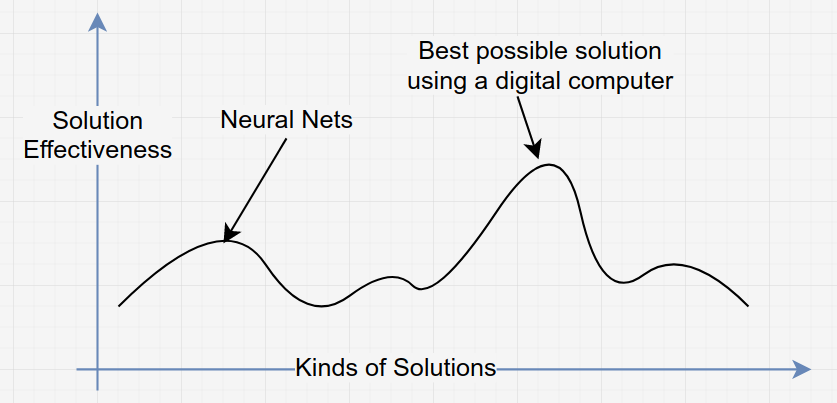
There have been some huge advances with neural networks, and some of the results are very promising. But at the same time, neural network techniques have not yet fully solved the problem, and I wonder if they may be approaching a local maximum in the solution space - a solution that's good, but not ideal:
handwriting_recognition_solutions.png
(39.37 KiB) Not downloaded yet
Because of this, I'm interested in exploring less conventional solutions. Also, whether I personally work on neural network solutions or not, they will continue to receive a great deal of attention due to their popularity and effectiveness.
New Member
#12
Like the other posters here, in the past 9 months I have taken great interest in automatic handwriting recognition for the purpose of indexing genealogical records. I took Andrew Ng's and Jeremy Howard's courses and am now working with a deep learning researcher at the Ohio State University on the problem. We have spent the last several months replicating BYU's approach and making it open source. We've been in contact a little with them about this. We just submitted a result to the 2018 ICFHR competition on making a general recognition solution that doesn't require additional training data. We're now trying to research and implement better approaches. All our code is on github, in a repository called Nephi. We welcome any contributors, all you need is access to an NVIDIA GPU.

The best open source platform for handwriting recognition is probably Transkribus, which is funded by the European Union. I am using their platform in conjunction with our code to transcribe hundreds of pages of my own handwriting. While their platform is easy to use and fully featured, they haven't yet made their algorithms open source, but instead offer their platform as a free service, while the project has funding.

If anyone is interested in talking more about these things, I can give you my email.
New Member
#13
Thanks for pointing this out! I found and starred that repo. My own individual efforts, in my free time, have been slow going and not too successful. I'm interested in looking more closely at this project and the techniques it uses.
New Member
#14
Yes, you are right that there are two problems, segmentation (where are the words on the page/also what is their semantic meaning like birth place/first name/etc.) and recognition (what are the letters/words, given a segmentation). In addition to improving each of these processes somewhat independently, people are also working on methods that do both at the same time. This is definitely possible, and I don't think it's too far off when we'll have methods that can take the spreadsheet from FamilySearch Indexing and together with an image of a document train the AI system. Tranksribus is one of the groups currently working on this problem. Seth Stewart from the BYU team just recently published a paper where with just a few pages of training data a neural network could output where all the handwritten text, machine text and dotted and solid lines are. The paper is titled:

"Document Image Page Segmentation and Character Recognition as Semantic Segmentation"

My collaborator and I are working on one mechanism that allows segmentation and recognition at the same time. It is called "attention" and has been used by a few people in the past 2 years for segmentation and recognition at the same time. We are currently working it into our github repo.

As for using human input to train and retrain AI, I think that's definitely possible for handwriting recognition. The systems can be set up to put out a confidence in the prediction. I think for the time being having the machine be one indexer in the current 2 indexers + arbitration is the best way to maintain accuracy. I think another next step could be to train a machine to be the arbitrator. I think that's definitely possible, but we may still need at least one human in the loop for now.
New Member
#15
Hi, this is my first post on this blog, and I would like to contribute with some ideas that may help doing handwriting recognition (HWR).
In fact I was just reflecting on the way a "human scanner" browse through records (eg vital records like birth, deaths, etc) to identify meaningful info.

While going through a batch of vital records, looking for specific information, our mind first builds a "template" of where the relevant fields are (name, surname, parents, birth date, etc), then "instructing our eyes" to jump to the key record(s) we are interested in (usually a name), thus dramatically speeding up the manual scanning process.
This also works well because most of a typical vital record is made up by "formulas" that are pretty common to the same batch, like "on the day XY, in front of me XYZ , in my quality of civil officer of the municipality of....." - a lot of junk you typically just skip!

I believe that the same thing could be done with an AI engine , by implementing a simple strategy like:
1) setting up a "semantic template" for each specific batch of documents, identifying repeating "formulas"
2) track the output of the HWR for the first few records, fine tuning the template
3) track a few more recognized records , "teaching" the system to improve interpretation.
4) get an alert and intervene if a specific record doesn't seem to follow the template

This may not be the "killer app" that reads all records whatever, but would certainly speed up by at least two orders of magnitude the digitization of handwritten records.

I think it mimics what Mail services do to automatically sort handwritten envelops by destination.
It's way easier to interpret the meaning of a field if you already know what type of info is in there, and a template would just do that.

Thoughts?